Botta Felice Antonio

Felice Botta (1931–2021)
The Essence of Form and the Soul of Salvage
Felice Antonio Botta was one of the most sensitive interpreters of design and Arte Povera in Italy. Born in Florence in 1931, in the historic Oltrarno district, he absorbed the artisanal wisdom of his city from a young age, training at the Istituto d’Arte under the guidance of the great woodcut master Pietro Parigi.
His artistic journey, spanning over sixty years, was a constant search for the essential—a philosophy of “taking away” to reveal the hidden beauty within forgotten things.
The Philosophy of Interno 9
In 1975, he founded his historic workshop, Interno 9, in Antella (Bagno a Ripoli). Here, Botta gave life to a vast production ranging from graphic arts and sculpture to poetic stationery and toy design. His mastery earned international acclaim:
- Design: Selected for the Compasso d’Oro in 1970 and a participant in the 14th Milan Triennale.
- Education: An 11-time winner of the prestigious European Spielgut award, granted to objects capable of stimulating children’s intelligence and imagination.
- Exhibitions: His works have been showcased in galleries worldwide, with milestone exhibitions in Tokyo (1985), Naples (1988), and New York (1992).
The “Legni” (Woods): Sculptures of Memory
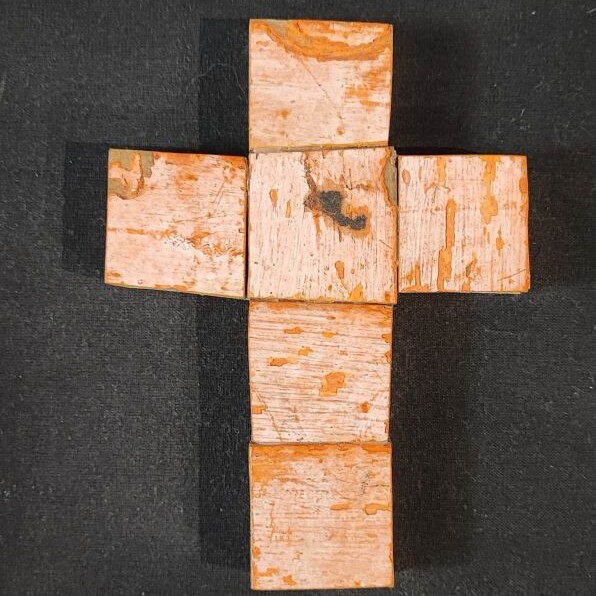
Felice Botta’s work with wood represents the perfect synthesis of ethics and aesthetics. He did not seek noble materials; he preferred reclaimed wood: old construction beams, planks from packing crates, driftwood smoothed by the sea, or carpentry scraps.
- Respect for the Material: Botta’s intervention was minimal. A crack, a wormhole, or a knotty grain became the eye of a whale, the beak of a bird, or the profile of a Pinocchio.
- Sustainability and Poetry: A pioneer of creative recycling, he demonstrated that “waste” possesses a higher dignity when viewed through the eyes of imagination. His sculptures do not hide the material’s past; they celebrate it, making every piece unique and unrepeatable.
An Artistic Legacy
Beyond his famous wooden sculptures, Botta is remembered for his “Artist’s Stamps”, his works in recycled paper, and his notebooks, which are today cult objects for collectors and lovers of minimalist design. His passing in 2021 left a void in the Tuscan art scene, but his message remains more relevant than ever: true wealth does not lie in possession, but in the capacity to marvel at simplicity.
“In my hands, wood does not die; it only changes form to continue telling its story.”